Other Professional Courses2026-3 Edition100% Free Video Course

Pikuma – 2D Game Physics Programming

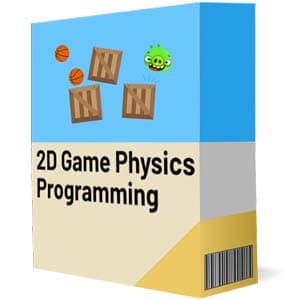
2D Game Physics Programming is a two-dimensional game physics programming course published by Pikuma Online Academy. In this training course, you will learn all the theories and mathematics behind the physics of 2D games and create a physics engine from scratch with C++. This training course is a gentle introduction to the world of 2D game physics! You’ll learn all the beautiful math that provides the foundation for most physics engines, such as vectors, matrices, basic trigonometry, as well as calculus. In this course you will also learn about several physics topics such as velocity, acceleration, integration, mass, force, gravity, tension, friction, rigid body dynamics, collision detection, constraints, etc.You will also put theory into practice by coding a very simple 2D physics engine from scratch using the C++ programming language. First, you will start by writing a simulation of particle physics and you will pay attention to concepts such as motion, forces, displacement. You will then continue working with solids by adding shapes to our objects such as circles, rectangles, and polygons. Finally, you will finish building your game by adding constraints to your physics engine. This training course is recommended to all people who are interested in 2D game physics programming and want to create a game with great physics for themselves.
4.4
(7 reviews)
55.7 Hours On-Demand
Created by Senior Industry Specialist
Uploaded Sep 2026
English
Pikuma – 2D Game Physics Programming
Preview This Course
Free$129.99100% Free

Instant high-definition streaming with zero paywalls.

Course Features:
55.7 hours on-demand video
192 complete lectures
1 downloadable project zip file(s)
Streamable on mobile, tablet & desktop
Self-paced curriculum with progress tracking
Direct MP4 downloads & offline video access
Verified course archives hosted on cloud infrastructure.

What You'll Master in this Course

Concepts and principles of two-dimensional game physics programming
Building a physics engine with C++
Various mathematical topics
Physical concepts such as speed, acceleration, integration and mass
And …

Course Curriculum192 Lectures

1 sections • 55.7 hours total length

Prefer offline learning? Download all 192 video lectures and project files for free.
Download Free
How to Take this Course
Preview
2m
A Quick Review of Vector Math
Preview
3m
Introduction & Learning Outcomes
21m
What is Game Physics
12m
Using the P5js Web Editor
6m
Visualizing Errors in the Web Editor
1m
Coding a Vec2 Class
7m
Vector & Scalar Quantities
31m
Vector Magnitude
20m
Vector Equality
6m
Vector Addition & Subtraction
22m
Scaling Vectors
7m
Methods for Vector Addition & Subtraction
7m
Static Methods
4m
Applications of Vector Addition & Subtraction
15m
Is the Dot Product Commutative
7m
Dot Product
27m
Cross Product
24m
Coding the Cross Product Method
6m
Exercise Perpendicular 2D Vector
8m
Perpendicular 2D Vector
5m
Vec3 Methods
5m
Exercise Vec3 Methods
4m
Coding the Normalization Method
3m
Vector Normalization
16m
Scaling, Translating, and Rotating Vectors
20m
Quick Review of Sine & Cosine
19m
Vector Rotation Proof (y-component)
16m
Coding the Vec2 Rotate Method
11m
Concluding our JavaScript Vector Class
5m
Vector Rotation Proof (x-component)
45m
Vec2 C++ Header File
7m
Vec2 Operator Overloading
15m
A Quick Look at C++ Vec2 Syntax
19m
Technologies & Dependencies
18m
Folder Structure
31m
Compiling using GCC & Linux
9m
Makefile
4m
Initial Project Files
20m
Configuring Visual Studio on Windows
15m
Particle Class
11m
Particle Velocity
7m
Introduction to Particle Physics
29m
Using the + Operator to Add Vectors
3m
Clamping Invalid DeltaTime Values
3m
Controlling our Framerate
26m
Framerate Independent Movement
23m
Moving in a Constant Velocity
15m
Keeping the Particle Inside the Window
12m
Constant Acceleration
9m
Changing the Particle's Velocity
16m
Particle Integrate Function
4m
Discrete vs. Continuous
31m
Different Integration Methods
22m
Integration & Movement Simulation
36m
Applying Forces to Particles
31m
Function to Add Force
8m
Particles with Different Mass
12m
The Weight Force
17m
Inverse of the Mass
4m
Applying Forces with the Keyboard
5m
Drag Force Function
13m
Drag Force
35m
Unexpected Drag Behavior
2m
Handling Mouse Clicks with SDL
4m
Friction Force
20m
Friction Force Function
8m
Gravitational Attraction Force Function
16m
Gravitational Attraction Force
31m
Spring Force
35m
Spring Force Function
18m
Exercise Spring Forces
15m
Multiple Particles Chain
17m
Multiple Particles Soft body
13m
Soft Bodies & Verlet Integration
21m
Rigid-Bodies
20m
Shapes
15m
Shape Class
6m
Shape Class Implementation
16m
Angular Velocity & Angular Acceleration
22m
Circle Shape
11m
Torque & Moment of Inertia
36m
Circle Shape Angular Motion
20m
Box Vertices
24m
Local Space vs. World Space
21m
Body Update Function
4m
Why Not a Shape Draw Function
7m
No Draw Method in the Shape Class
5m
Circle-Circle Collision Detection
23m
Circle-Circle Collision Class
15m
Circle-Circle Collision Implementation
10m
Collision Contact Information
22m
Implementing the Projection Method
5m
Collision Information Code
29m
Broad Phase & Narrow Phase
28m
Objects with Infinite Mass
14m
The Projection Method
29m
Impulse Method & Momentum
20m
Impulse
21m
Simplifying the Impulse Method Formula
28m
Is Linear Collision Response Enough
14m
Coding the Linear Impulse Method
16m
Deriving the Linear Impulse Formula
54m
AABB Collision Detection
26m
Polygon-Polygon Collision Code
15m
Finding Minimum Separation with SAT
29m
SAT Separating Axis Theorem
39m
Code to Find SAT Minimum Separation
28m
Refactoring the SAT Separation Function
7m
Finding Extra Collision Information with SAT
13m
Polygon-Polygon Collision Information
14m
Linear & Angular Velocity At Point
28m
Computing Linear & Angular Impulse
26m
Post-Collision Velocity At Point
33m
Collision Distance Vectors Ra-Rb
18m
D Cross Product Simplification
15m
Coding the Impulse Along Normal
15m
Friction Impulse Along Tangent
13m
Exercise Impulse Along Tangent
23m
Removing Window Boundaries Check
6m
Circle-Polygon Collision Detection
14m
Finding Polygon's Nearest Edge with Circle
6m
Exercise Circle-Polygon Edge Regions
8m
Circle-Polygon Collision Information
26m
Circle-Polygon Collision Resolution
11m
Polygon with Multiple Vertices
6m
Exercise Polygons with Multiple Vertices
23m
Rendering Circle Texture
11m
Loading SDL Textures
14m
World Class
15m
Implementing World Functions
20m
Refactoring Function to Update Vertices
10m
Local Solvers vs. Global Solvers
17m
A Naive Iterative Positional Correction
26m
Constrained Rigid-Body Physics
40m
Example Velocity Constraint & Bias Factor
12m
Position vs. Velocity Constraints
33m
Example Distance Constraint & Bias Factor
8m
The Constraint Class
6m
Constraint Forces & Constrained Movement
33m
VecN Class
17m
Force-Based vs. Impulse-Based Constraints
39m
Implementing VecN Functions
8m
VecN Operator Overloading
9m
Matrices
18m
MatMN Class
9m
Matrix Transpose
10m
Matrix Multiplication
24m
Matrix Multiplication Function
4m
Seeing Beyond the Matrix
10m
Constraint Class Inheritance
7m
Generalized Velocity Constraint
42m
Solving Violated Velocity Constraints
36m
Distance Constraint
39m
Joint Constraint Class
8m
Converting World Space to Local Space
6m
World List of Constraints
15m
Refactoring Body Update
27m
Populating the Distance Jacobian
13m
Deriving the Distance Jacobian
46m
Gauss-Seidel Method
6m
Constrained Pendulum
13m
Solving System of Equations (Ax=b)
28m
Solving System of Constraints Iteratively
24m
Adding the Bias Term
8m
Warm Starting
29m
Ragdoll with Joint Constraints
16m
Preventing NaN Errors
4m
Penetration Constraint
26m
Deriving the Penetration Jacobian
20m
Solving Penetration Constraints
7m
Penetration Constraint Class
31m
Penetration Warm Starting
6m
Penetration Constraint Friction
16m
Clamping Friction Magnitude Values
8m
Penetration Constraint Bounciness
11m
Unstable Stack of Boxes
20m
Allowing for Multiple Contact Points
22m
Reference & Incident Edges
17m
Finding Incident Edge
25m
Getting Ready for Clipping
22m
Clipping Function
18m
Testing Multi-Contact Boxes
5m
Testing Multiple Objects & Constraints
20m
Broad & Narrow Split
6m
Continuous Collision Detection
14m
Contact Caching
28m
Euler Integration Review
47m
MidPoint & RK4 Integrators
30m
Stick Constraints
44m
Verlet Integration
39m
Conclusion & Next Steps
27m

Requirements

  • Basic enthusiasm to learn and follow along with lessons
  • A computer or mobile device with a modern internet connection

Description

2D Game Physics Programming is a two-dimensional game physics programming course published by Pikuma Online Academy. In this training course, you will learn all the theories and mathematics behind the physics of 2D games and create a physics engine from scratch with C++. This training course is a gentle introduction to the world of 2D game physics! You’ll learn all the beautiful math that provides the foundation for most physics engines, such as vectors, matrices, basic trigonometry, as well as calculus. In this course you will also learn about several physics topics such as velocity, acceleration, integration, mass, force, gravity, tension, friction, rigid body dynamics, collision detection, constraints, etc.You will also put theory into practice by coding a very simple 2D physics engine from scratch using the C++ programming language. First, you will start by writing a simulation of particle physics and you will pay attention to concepts such as motion, forces, displacement. You will then continue working with solids by adding shapes to our objects such as circles, rectangles, and polygons. Finally, you will finish building your game by adding constraints to your physics engine. This training course is recommended to all people who are interested in 2D game physics programming and want to create a game with great physics for themselves.

Instructor

S

Senior Industry Specialist

Specialist in Other Professional Courses

Passionate educator focused on real-world practical skills, modern frameworks, and production-ready engineering practices. Delivering step-by-step masterclasses accessible to learners globally on MJ Accedemy.

Recommended Curriculum

Students Also Viewed